How to Compare Cloud Storage Pricing for a Small Team
Two plans at the same $7.00 per user per month hand a ten-person team 10 TB or 300 GB, depending on whether storage is allocated per user or pooled across the organisation. Figures from the three vendors' own pages, read October 13, 2026. Box's prices could not be read.
This article is a documentation review: it is based on the vendors' own published pages, checked on the date shown. We may earn a commission from some links; it never affects what we recommend.

Cloud storage for a team is priced per user, which makes the rates look comparable and the capacity unequal. Google Workspace allocates storage per person and then pools it across the organisation. Microsoft 365 allocates a fixed amount to each user.
Dropbox pools one team allowance that barely moves as seats are added. This note reads the three vendors' pricing pages on October 13, 2026, and works both the annual bill and the gigabytes for a ten-person team.
Box was also attempted; its prices could not be read.
Check whether the storage is pooled or per user
Google Workspace states 30 GB pooled storage per person on Starter, 2 TB on Standard and 5 TB on Business Plus. A footnote explains it: storage is provided per user and shared across the organisation.
Microsoft 365 Business Basic states 1 TB of cloud storage per user, as does Microsoft 365 Apps for business. The allocation follows the seat rather than sitting in a shared pool.
Dropbox pools a team figure instead of a per-seat one. Standard states it starts at 3 TB for the team and Advanced starts at 15 TB for the team, restated in the comparison table as 3,000 GB and 15,000 GB.
Those three sentences decide the purchase more than the rates do, the way structure beats rate in how to read a help desk pricing page.
Work the annual bill and the gigabytes for ten people
Editorial calculation, ten users, list prices as of October 13, 2026, no promotional discount applied, capacity as each page states it:
- Google Workspace Starter: 10 x $7.00 x 12 = $840 a year, 300 GB pooled
- Microsoft 365 Business Basic: 10 x $7.00 x 12 = $840 a year, 1 TB per user, so 10 TB
- Microsoft 365 Apps for business: 10 x $10.00 x 12 = $1,200 a year, 1 TB per user
- Google Workspace Standard: 10 x $14.00 x 12 = $1,680 a year, 2 TB per person pooled, so 20 TB
- Dropbox Standard: 10 x $15 x 12 = $1,800 a year, starts at 3 TB for the whole team
- Google Workspace Business Plus: 10 x $22 x 12 = $2,640 a year, 5 TB per person pooled
- Dropbox Advanced: 10 x $24 x 12 = $2,880 a year, starts at 15 TB for the whole team
The first two lines cost the same and differ by more than thirty times in capacity. At $7.00 per user per month, Microsoft states 1 TB each and Google states 30 GB each, which is 10 TB against 300 GB for ten people.
That does not make one plan better. Google Starter also buys custom email, video meetings for 100 participants and an AI assistant in Gmail, so storage is not what the $7.00 is for.
It does mean the per-gigabyte comparison is meaningless without the feature list beside it. The same trap sits inside per-seat software generally, as what per-agent pricing means when agents are part-time describes.
Dropbox charges most per gigabyte at the entry tier
Dropbox Standard at $15 per user per month gives a ten-person team 3 TB in total, less than a third of what Microsoft Business Basic allocates at $7.00. Dropbox Plus, for one person, gives 2 TB at $9.99 a month.
What the higher tiers buy is recovery and transfer, not capacity. Dropbox states 30 days to restore deleted files on Plus, 180 days on Standard and one year on Advanced, with transfers up to 50 GB on Plus and 100 GB above it.
A one-year restore window is a real difference from a 30-day one, and it is a term that only matters once. Price it as insurance, not storage.
Dropbox also sets the only explicit seat floor here. Standard reads for 1 person or more and Advanced for 3 people or more, so a two-person team cannot buy Advanced.
Floors like that are priced out in how to compare password manager pricing for a small team.
Google's introductory price is capped at twenty users
Google Workspace showed two prices for each business plan on October 13, 2026. Starter appeared as $7.00 standard and $3.50 introductory at 50 percent off, Standard as $14.00 and $8.40 at 40 percent off.
The price details panel dated the discount window Oct 27, 2026 to Oct 27, 2027, marked it limited to 20 users, and showed $7.00 for all users from Oct 27, 2027 onwards.
A footnote narrows it further: the introductory price is for new customers only and applies to the first 20 users added, for 12 months, after which standard pricing applies to everyone.
Budget the standard rate and treat the first year as a credit. A ten-person team on Starter pays $420 in year one and $840 in year two, by editorial calculation.
The page adds that all plans are billed monthly, all prices are in USD, and the per-user price may vary by about 0.01 percent due to rounding. A separate annual option offers 16 percent off with a one-year commitment.
Microsoft's ceiling is the tenant, not the plan
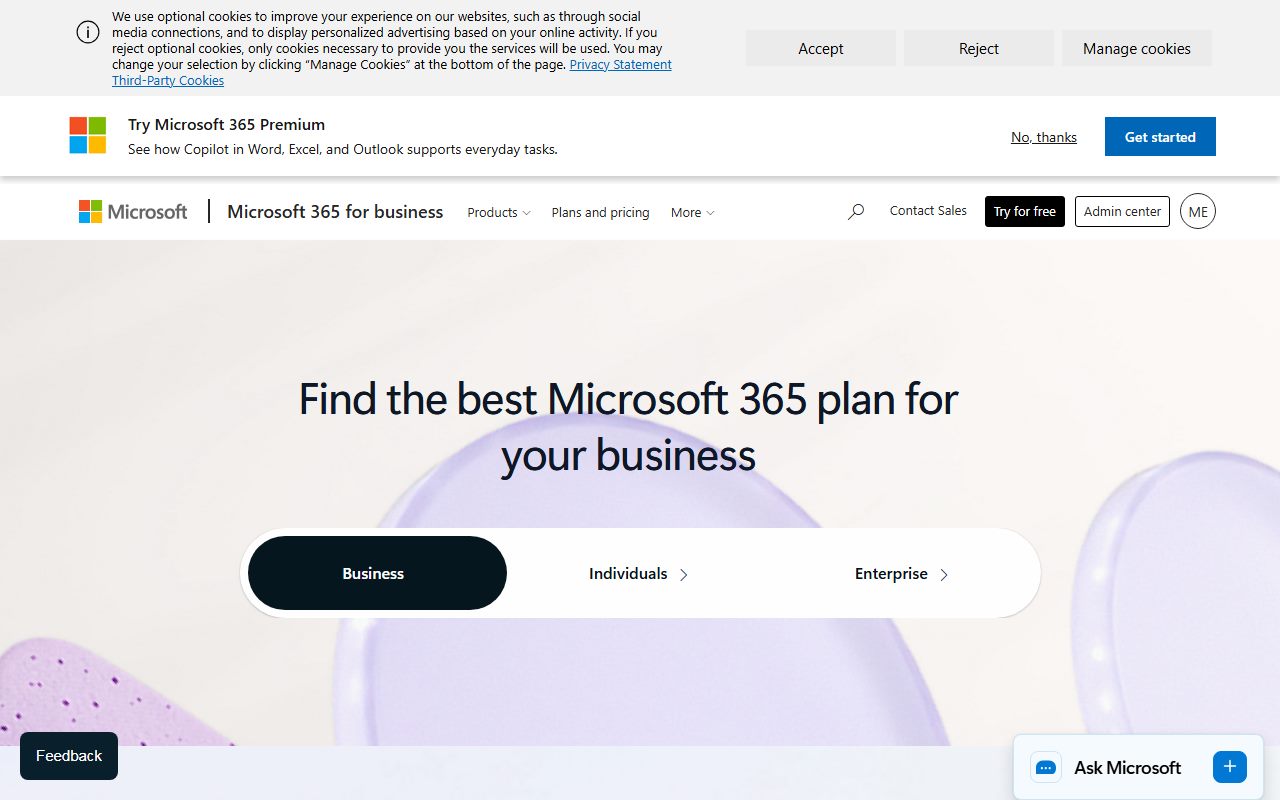
Microsoft 365 Business Basic at $7.00 per user per month is sold as an annual subscription that auto-renews, paid yearly. Apps for business is $10.00 on the same basis.
The featured view also printed Business Standard with Copilot at $23.50 and Business Premium with Copilot at $32.00, same basis. The plain versions of both were not priced on that view.
The limit to watch is the tenant. Microsoft states its business base plans are designed for up to 300 users, and that it reserves the right to enforce a 300-licence limit across the family.
Google states the same 300-user maximum on Starter, Standard and Plus, with no limit on Enterprise. Both caps sit far above a small team.
Microsoft's cancellation terms are tighter than a trial: a 7-day window for a prorated refund once a paid subscription begins. Dropbox offered 30 days free and Google 14. Short windows change what can be tested, as in how to read a help desk pricing page.
What could not be read
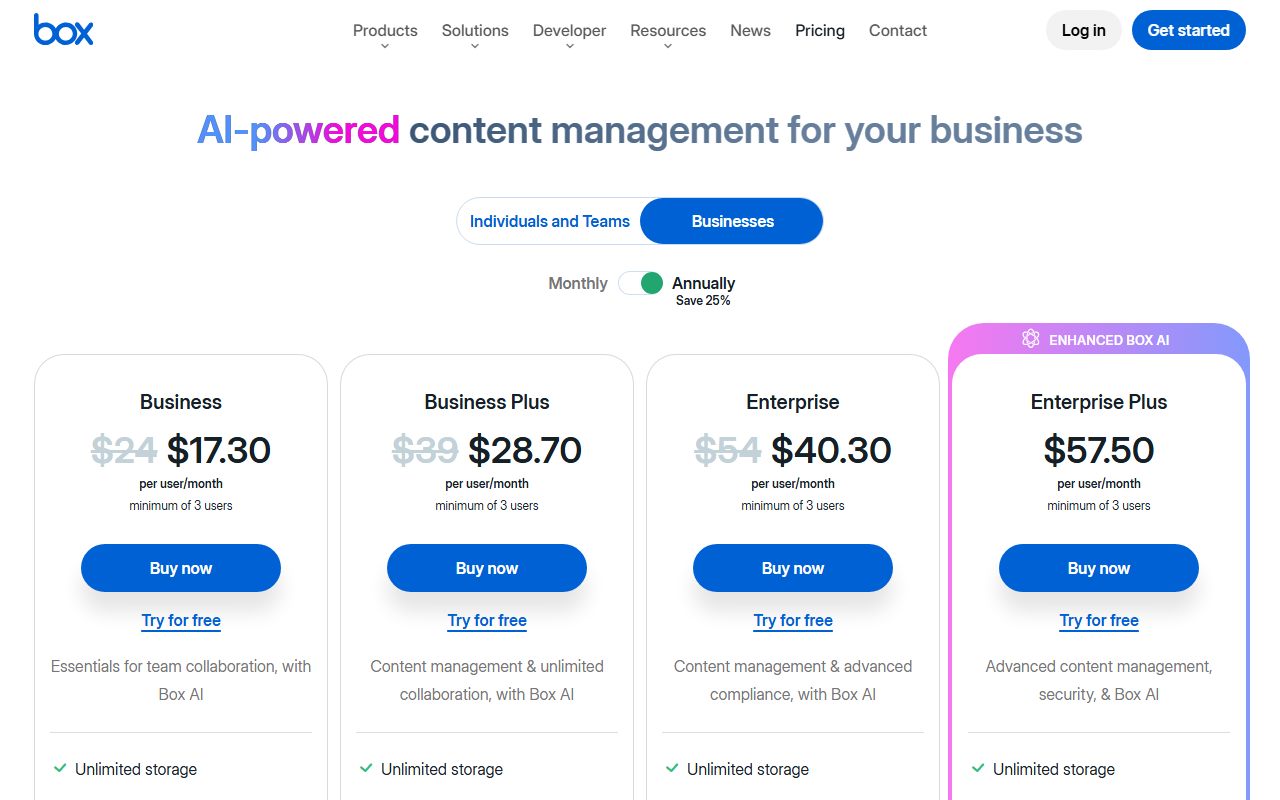
Box's pricing page loaded its plan structure but not its prices on October 13, 2026. The header stated from $5 per user per month while the plan cards rendered without amounts, and a direct page dump hit a bot-protection challenge.
What the page did state is still useful: a minimum of 3 users on every business plan, 100 GB on Business Starter with a 2 GB file upload limit, and unlimited storage on Business and above with upload limits of 5 GB and 15 GB.
Box is therefore not in the ten-person table. Read its prices directly rather than trusting third-party lists, which go stale within a quarter.
Bottom line
For ten people, the published annual bills run from $840 on both Google Workspace Starter and Microsoft 365 Business Basic to $2,880 on Dropbox Advanced, as of October 13, 2026.
Choose on structure. Per-user allocation if people keep large local libraries, pooled storage if a few shared drives hold everything, Dropbox only if the longer restore window is worth the premium.
Then price year two, because Google's introductory rate expires and covers only the first 20 users. Promotional pricing hides like an allowance does in what unlimited calling really means in business phone plans.
Confirm the seat floor too. Dropbox Advanced needs three people and Box needs three on every business plan, the minimum that reshapes a small bill in how to compare password manager pricing for a small team.
Frequently asked questions
How much cloud storage does $7 a user buy?
It depends on the vendor. Microsoft 365 Business Basic at $7.00 per user per month paid yearly states 1 TB per user. Google Workspace Starter at $7.00 states 30 GB pooled per person, so 300 GB for ten people, as of October 13, 2026.
What does pooled storage mean?
Google Workspace provides a per-user amount that is shared across the organisation, so one person can use more than their allocation if colleagues use less. Microsoft 365 allocates 1 TB to each user instead, and Dropbox pools a single team figure from 3 TB.
Is Dropbox more expensive than Google Workspace for a team?
At the entry tier, yes, on both counts. Dropbox Standard is $15 per user per month with 3 TB for the whole team, against Google Workspace Starter at $7.00 with 30 GB per person: $1,800 against $840 a year for ten users.
Does Google Workspace have a minimum or maximum number of users?
The page states no minimum and a maximum of 300 users on Starter, Standard and Plus, with no limit on Enterprise. The introductory discount is separately limited to the first 20 users added, for 12 months.
How long is the free trial for business cloud storage?
Dropbox's page offered 30 days free and Google Workspace offered 14 days, as of October 13, 2026. Microsoft states a 7-day cancellation window for a prorated refund after a paid subscription begins rather than a trial length.
Sources
- Dropbox plans, yearly billing (Plus $9.99 a month with 2 TB, Standard $15 per user per month for 1 person or more starting at 3 TB for the team, Advanced $24 for 3 people or more starting at 15 TB, 30-day and 180-day and 1-year restore windows, 30-day free trial) (checked Oct 13, 2026)
- Google Workspace pricing (Starter $7.00 standard and $3.50 introductory with 30 GB pooled per person, Standard $14.00 and $8.40 with 2 TB, Business Plus $22 with 5 TB, all prices $USD and billed monthly, 300-user maximum, introductory price limited to first 20 users for 12 months, 14-day trial) (checked Oct 13, 2026)
- Microsoft 365 business plan comparison, US store (Business Basic $7.00 user/month paid yearly with 1 TB per user, Apps for business $10.00, Business Standard with Copilot $23.50, Business Premium with Copilot $32.00, 300-licence tenant limit, 7-day cancellation window) (checked Oct 13, 2026)
- Box pricing (plan structure, 3-user minimum on every business plan, 100 GB on Business Starter, unlimited above it, 2 GB to 15 GB upload limits; plan prices did not render and a direct page dump returned a bot-protection challenge) (checked Oct 13, 2026)