What Unlimited Calling Really Means in Business Phone Plans
Every business phone vendor sells unlimited calling with an asterisk. Here is what the fair-use policies, minute pools, SMS registration fees, and seat minimums at Quo, Nextiva, RingCentral, and Dialpad actually say, as of October 2026.
This article is a documentation review: it is based on the vendors' own published pages, checked on the date shown. We may earn a commission from some links; it never affects what we recommend.
Unlimited calling is the most repeated promise on business phone pricing pages, and the least defined. Every major vendor attaches an asterisk to it. The asterisk points to a fair-use policy, a minute pool, a country list, or a seat minimum that the headline price never mentions. This note explains what those footnotes mean in practice. It is based on the public pricing pages and legal terms of Quo (formerly OpenPhone), Nextiva, RingCentral, and Dialpad, read in October 2026. No accounts were opened and no calls were placed for this note. Every figure below comes from the vendor's own page, and where a page could not be read, the gap is stated rather than filled.
Start with the country list, not the word unlimited
Unlimited almost always means the United States and Canada, nothing more. RingCentral's pricing FAQ states that "for external calls, you get unlimited phone calls within the US and Canada," with other countries handled through separate international plans and bundles (checked October 2026).
Dialpad's terms of service describe "unlimited monthly calling for domestic calls (United States and Canada)" and exclude international calls from unlimited plans. Its rates page adds that unlimited covers "your billing country, the U.S. and Canada," so a UK account gets a different bundle.
Quo (formerly OpenPhone) lists US and Canada calling as "Unlimited*" on every plan on its pricing page, as of October 2026. Calls anywhere else are an add-on billed through credits at per-minute rates by destination, published on a separate rates page.
Nextiva's small-business pricing page advertises unlimited calls and video meetings but does not name a region, and does not mention international calling at all. Its UCaaS service terms state that international calling is billed as usage at then-current rates, in arrears.
Read the fair-use policy before you count on heavy volume
Every unlimited plan is unlimited only for "normal" use, and the vendor decides what normal means. None of the four policies read for this note publishes a monthly minute number, so the cap is a judgment call made after the fact.
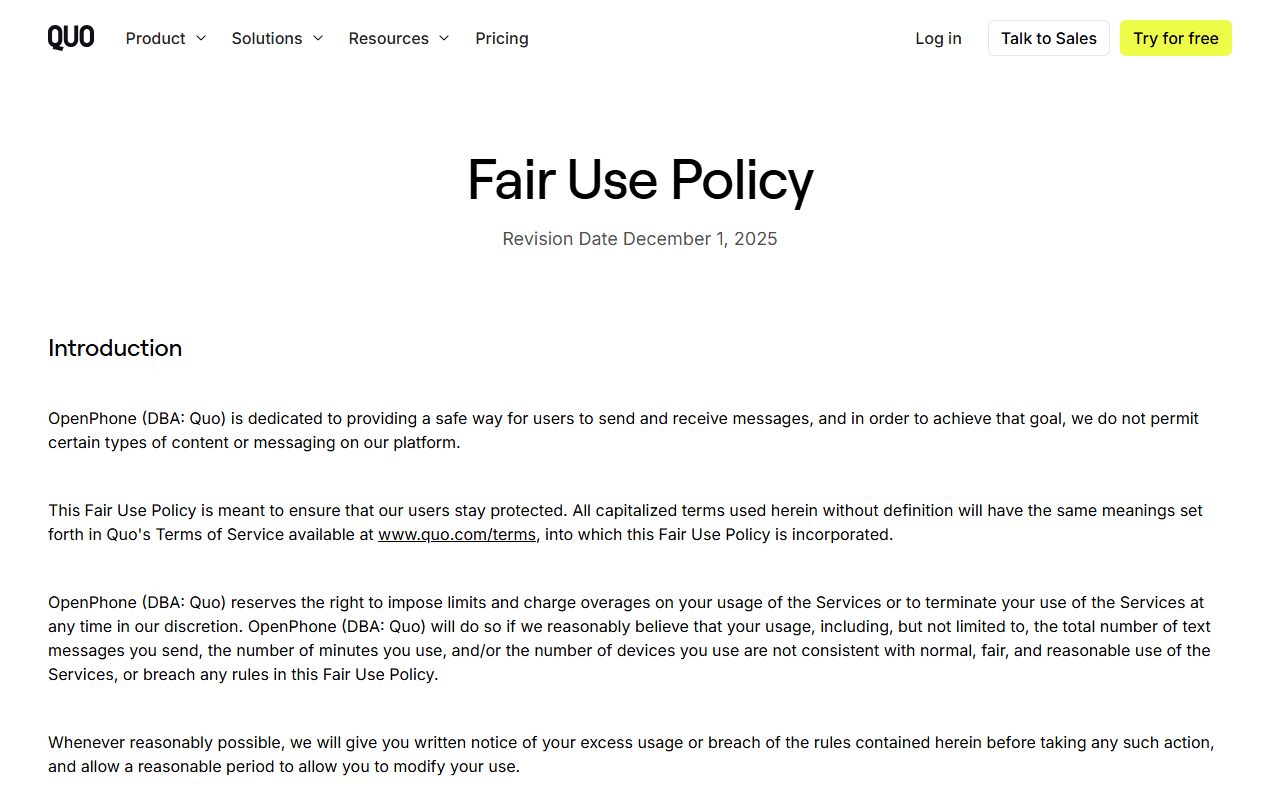
Quo's fair-use policy applies when usage is "not consistent with normal, fair, and reasonable use." Examples include "excessive short-duration calls or abnormal spikes in call attempts" and calling "large numbers of unique or sequential phone numbers." Quo may "impose limits and charge overages" or terminate.
Nextiva's acceptable-use policy defines excessive use as use that "substantially exceeds the average volume, nature or duration of calls." It flags calls to the same number lasting over four hours, and may add a per-call charge when calls under 10 seconds become excessive.
RingCentral's acceptable-use policy prohibits use "in excess of reasonable business use" and says RingEX is not for "high-volume commercial messaging or call center calling." No number is given. Dialpad has one measurable rule: 100 or more bulk voicemails at once counts as blasting.
Check which uses are banned outright
The fair-use clauses are vague on volume but specific on behavior. The same activities appear on every list, so a business built around them should not buy an unlimited seat plan at all.
- Auto-dialing and predictive dialing: banned by Quo, RingCentral, Dialpad, and Nextiva. Nextiva allows it only inside its Contact Center product with express authorization.
- Trunking or forwarding the number into a PBX or any system that handles multiple simultaneous calls: banned by RingCentral and Dialpad. Nextiva bars aggregating traffic from more than one customer over a line.
- Call-center style inbound lines, hotlines, and 900-type numbers: excluded from Dialpad's unlimited services. RingCentral excludes "call center calling" from RingEX.
- Telemarketing, cold calling, and prerecorded campaigns without consent and opt-out language: barred by Quo and Nextiva, and covered by spam rules at RingCentral and Dialpad.
- Sharing one line among several people: Dialpad limits each line to normal single-user use.
The practical test is simple. If the phone is a sales floor or a support queue, the vendor's contact-center product with metered minutes is the honest fit. Unlimited seats are priced for one person making and taking a normal day of calls.
Separate the unlimited calls from the minute pools
Vendors sell unlimited internal and outbound calling, then meter three other things: toll-free inbound, SMS, and international. These pools are where a small team's bill actually moves, and they are rarely on the headline card.
Nextiva's pricing page (October 2026) includes no toll-free minutes on Core, "up to 2,000" on Engage, and "up to 10,000" on Scale. Texts per user per month run 100, 500, and unlimited. Its terms add that "unused usage does not roll over."
Dialpad's rates page sets Connect seats at 250 outbound US texts a month, then $0.008 per message. RingCentral's public plans page lists a $25 Business SMS Booster add-on but did not expose its per-plan SMS and toll-free allowances in the version read for this note.
Quo publishes no SMS cap for US and Canada, marking messaging "Unlimited*" under the same fair-use policy. Automated texts sent through its API, Zapier, or Make are the exception at $0.01 per outgoing message, as of October 2026.
Budget for SMS registration fees that sit outside the plan price
Any US business texting from a local number must register with The Campaign Registry (TCR) before AT&T, T-Mobile, and Verizon will deliver the messages. This A2P 10DLC rule is a carrier requirement, not a vendor upsell, and it is billed on top of the seat.
Quo is the clearest about the cost. Its pricing page lists a "$19.50 one-time" carrier review and setup fee charged by TCR, plus a messaging fee of "$1.50 - $3/month" by use case, as of October 2026. Unregistered traffic is not delivered.
Nextiva, RingCentral, and Dialpad require the same registration, but none of their public pricing pages read for this note states the fee. Expect the vendor to pass through TCR charges and to ask for an EIN, a website, and sample messages first.
Count the seats and the contract term before comparing prices
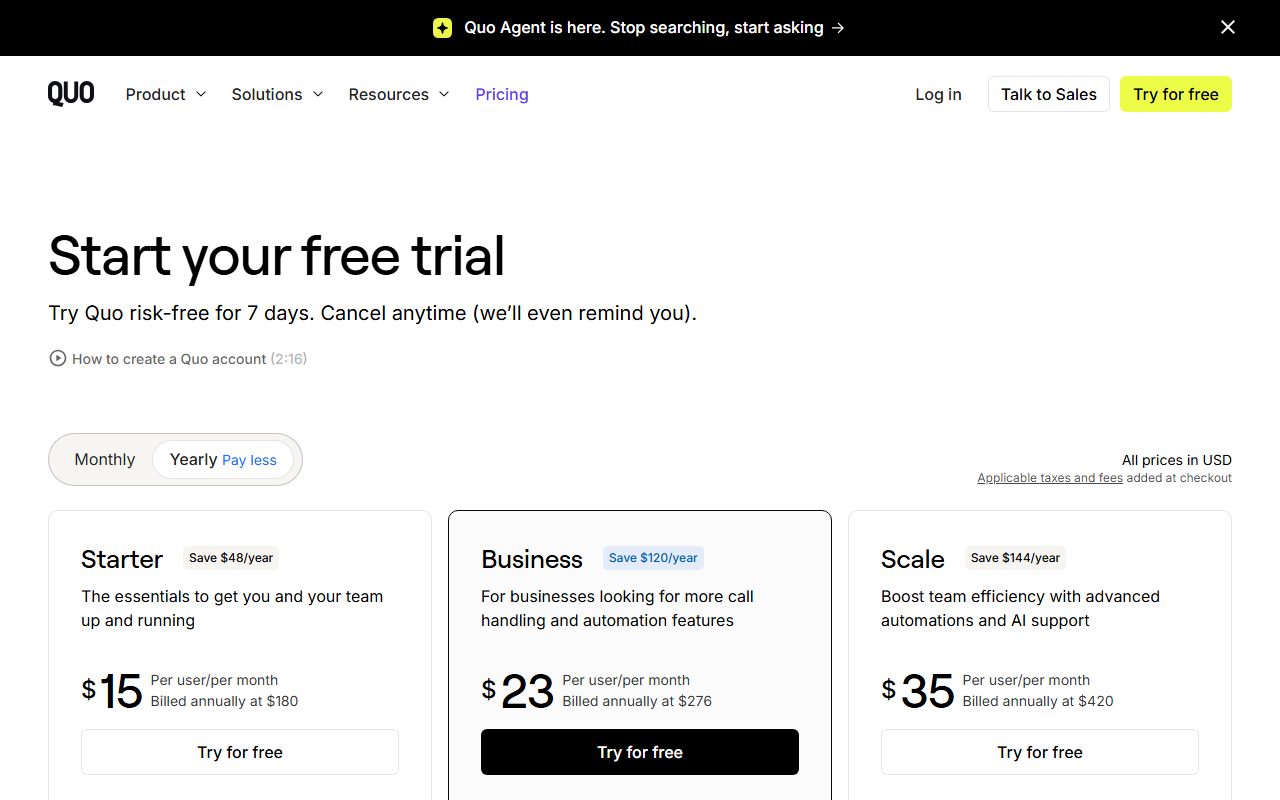
The per-user number on a pricing page assumes a billing term and sometimes a head count. Quo's $15 Starter, $23 Business, and $35 Scale prices are annual rates; monthly billing is $19, $33, and $47, as of October 2026. Quo lists no seat minimum.
Nextiva shows $15, $25, and $75 per user per month for Core, Engage, and Scale. The footnote restricts those prices to new small business customers with 1 to 100 employees "signing a paid 12-month or longer minimum term agreement." Month-to-month pricing is not displayed.
RingCentral's page says "save up to 33% by paying annually" but, in the version read, did not display Core, Advanced, and Ultra per-user prices. Dialpad's pricing page rendered its tiers as unreadable images, so its per-seat prices and license minimums are not quoted.
Grasshopper's pricing page returned only a regional notice ("available only in the USA and Canada") with a "starting at $14/month" headline, so it is left out of this comparison rather than guessed at.
As an editorial calculation, five Quo Business seats cost 5 x $23 = $115 a month on annual billing, plus the $19.50 TCR fee and $1.50 to $3 monthly. Five Nextiva Engage seats cost 5 x $25 = $125 on a 12-month term.
The gap between the two is not the headline $2 per seat. It is whether your toll-free and SMS volume fits inside Nextiva's pool, and whether your calling pattern stays inside Quo's undefined idea of normal.
Bottom line
Unlimited calling is a US and Canada feature with a behavior clause attached, not a volume guarantee. Before signing, read the fair-use or acceptable-use policy, not just the pricing page. Confirm the toll-free and SMS pools and whether they roll over.
Add the TCR registration fee to any plan that will text. Then price the plan at your real seat count and billing term, because the advertised rate usually assumes annual payment and, at Nextiva, a 12-month contract.
Frequently asked questions
Does unlimited calling include international calls?
No, at the four vendors read for this note. Unlimited covers the US and Canada, plus the billing country at Dialpad. International calls are billed per minute by destination or sold as separate bundles, as of October 2026.
Can a vendor cancel my unlimited plan for using it too much?
Yes. Quo, Nextiva, RingCentral, and Dialpad all reserve the right to limit, charge overages, or terminate service that exceeds "normal" or "reasonable" business use. None publishes a minute threshold, so the decision is made case by case.
Why am I charged a registration fee to send texts?
US carriers require A2P 10DLC registration through The Campaign Registry before delivering business texts from local numbers. Quo lists the fee at $19.50 one-time plus $1.50 to $3 a month, as of October 2026. Other vendors pass through similar charges.
Sources
- Quo pricing page (checked Oct 9, 2026)
- Quo fair use policy (checked Oct 9, 2026)
- Quo terms of service (checked Oct 9, 2026)
- Nextiva pricing page (checked Oct 9, 2026)
- Nextiva legal terms (UCaaS service terms, acceptable use policy) (checked Oct 9, 2026)
- RingCentral plans and pricing page (checked Oct 9, 2026)
- RingCentral acceptable use policy (checked Oct 9, 2026)
- Dialpad legal (terms of service, acceptable use policy) (checked Oct 9, 2026)
- Dialpad rates page (checked Oct 9, 2026)